
Treatment Injury for Skiing Injuries - Advanced Therapeutic Approaches
Skiing is an increasingly popular and diverse activity combining downhill skiing, cross-country skiing, snowboarding, and freestyle skiing. The playing field has also changed significantly, moving from “bumpy” slopes to “boulevards” with increasingly steep gradients and therefore higher speeds, leading to a sharp increase in injuries.
The study on winter sports accidents, conducted each year by Médecins de Montagne (Epidemiological Network for the Observation of Winter Sports Accidents, 2023-2024 season report), provides telling figures:
- Figures and incidence - the incidence of injury risk represents an average of 2.6 injuries per 1,000 skier-days.
- Number of injuries - 136,700 for the 2023-24 season across the French mountains. 83% of skiers and 13% of snowboarders, with an average age of 31.
- Injury profile - 40% sprains (mainly ACL) and 25% fractures.
- Profile - Beginners on easy slopes are twice as likely to be injured, but the most serious injuries (head or spinal trauma) mainly occur on difficult slopes due to a combination of speed and lack of technical skill.
- Periods - Injuries are also more frequent at the end of the day or at the end of a trip.
Three Common Pathologies in Skiers
Ultimately, three pathologies cover the main accident-related problems in both experienced and
beginner skiers:
Acute: anterior cruciate ligament (ACL) rupture and its complications
Chronic: tendinopathies (patellar tendinopathy) or repetitive strain injuries (spine).
In this blog post, we will focus on ACL Rupture, and the role photobiomodulation, extracorporeal shock wave and neuromuscular electrostimulation can be used as part of the rehabilitation process.
ACL rupture is a major injury characterized by knee instability. It often occurs with an audible pop and is followed by rapid swelling (hemarthrosis). Consequently, the Anterior Drawer test needs to be done early.
Diagnosis - clinical examination (Lachman, anterior drawer, pivot-shift tests) is essential, often supplemented by MRI to assess associated injuries (menisci, collateral ligaments).
Treatment - may be conservative (rehabilitation alone) or surgical (ACL reconstruction, most often using the medial hamstring tendon (MST) with external reinforcement). The decision depends on the patient’s age, activity level, functional instability, and athletic expectations.
The Role of Photobiomodulation (PBM)
Although ACL treatment is dominated by surgery and rehabilitation, PBM can play an important supporting role in the post-traumatic or post-surgical phase. It is involved in the management of pain, inflammation, optimization of ligament healing, and regeneration.
The main mechanism of action of PBM is the absorption of photons by Cytochrome C Oxidase (CCO), a key enzyme in the mitochondrial respiratory chain.1 This stimulation increases ATP production: Activation of CCO increases the production of Adenosine Triphosphate (ATP), which boosts the cell’s metabolic activity. Then, the release of nitric oxide (NO), an inhibitor of CCO, results in local vasodilation and improved microcirculation. Finally, the increase in ATP and NO activates transcription factors, modulating the expression of genes involved in cell proliferation, anti-inflammation, and the production of growth factors.2
The use of PBM can be divided into two clinical scenarios:
A. Conservative Treatment and Acute Phase (Post-Trauma)
PBM will be used to control immediate symptoms and prepare the tissue for healing (in the case of stable
partial injury) or surgery (emergency surgery is generally only performed on high-level athletes).
Anti-inflammatory action: By modulating the production of pro-inflammatory cytokines (e.g., IL-1, IL-6, and TNF-α) and increasing anti-inflammatory factors, PBM reduces oedema.3
Analgesic action: It acts directly on nocioceptors (nerve conduction) and reduces the production of pain
mediators, contributing to non-pharmacological pain management.4
B. Post-operative (ligamentoplasty)
The main interest for surgeons and physical therapists is the potential impact on graft healing and
early rehabilitation.
PBM optimizes graft take up: It stimulates fibroblast proliferation and type I collagen synthesis (the main
collagen component of the ACL and the graft). This accelerates the critical phase of revascularization and
remodeling of the graft.5
Action on post-operative pain: Facilitating better pain management accelerates recovery of range of
motion (ROM).14
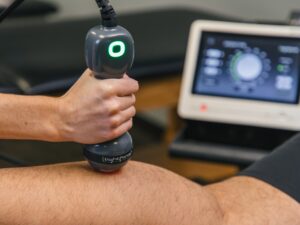
ESWT (EXTRACORPOREAL SHOCK WAVE THERAPY)
In the case of an acute injury such as ACL rupture, ESWT is rarely the first line of treatment for the ligament injury itself. The priority is stabilisation or surgery. However, some recent studies show that Extracorporeal Shock Wave Therapy can be used in combination with physical therapy following ACL ligamentoplasty:
Either immediately after surgery (day 2 post-op)
Low-power Radial Shockwave Therapy (RSWT) around the patella, plus 10 cm above the patella, thus
avoiding the surgical area, at a rate of one session per week for 6 weeks to improve function, pain, and
daily activities (Song et al 2024).6
Or in delayed post-op (6 or 8 weeks post-op):
Low-energy RSWT or FSWT on the joint center, femoral tunnel, and tibial tunnel to improve ACLR graft
maturation at two-year follow up. 15-16 Another study also showed a faster return to running and pivoting activities, which would be beneficial to skiiers (Weninger et al 2023). 7
Earlier studies demonstrated the effectiveness of ESWT following ligamentoplasty for:
- Pain or fibrosis in the Hamstring graft site at the Tendon Bone Insertion (TBI)
- On the Patellar tendon, if there is residual tendinopathy following a Bone tendon Bone graft (Savalli et al 2003).8
NEUROMUSCULAR ELECTROSTIMULATION (NMES)
NMES is used in the first few weeks after ACL surgery or trauma to combat Arthogenic Muscle Inhibition (AMI). Recent studies have also shown significant benefits of NMES for the Leg Symmetry Index (LSI), an important marker for return to training (>90%). The most benefit coming when it is combined with visualisation, motor reprogramming, proprioception and muscle strengthening exercises, especially during the transition from physical therapist to physical trainer (Labanca et al 2022).10 The combination of NMES and resistance exercise has also been shown to be beneficial for treating patella tendinopathies (Labanca et al 2022).11
Use of cryotherapy
First, the RICE will be implemented, including the use of Compressive Cryotherapy (Knee Universal Excell
Ice DonJoy®). This is the gold standard method for immediate post-operative care. It combines the effect of cold with intermittent or static pressure. The advantage of adding compression is that it is significantly more effective for draining effusion and oedema than cold alone, improving patient satisfaction and functional recovery. Standard recommendations include regular and repeated applications, often 3 times a day for 20 to 30 minutes, especially during the first 10 to 15 days. During rehabilitation sessions, the therapist will use it just before and/or after the sessions, as pain and oedema tend to increase after exercise. Given the choice, Photobiomodulation therapy (PBMT) should be prioritized over cryotherapy due to its broader and more effective range of action (Fisher et al 2019).12
Rehabilitation exercises
Rehabilitation is essential: it aims to quickly restore full joint range of motion, particularly extension, which is essential for normal walking and the prevention of arthrofibrosis. Early rehabilitation includes gentle passive and active mobilization, followed by strength training, proprioception, and specific return to sport exercises.13
References:
- Hamblin MR. Mechanisms and applications of the anti-inflammatory effects of photobiomodulation. AIMS Biophys. 2017;4(3):337-361. Epub 2017 May 19.
- Karu T. Mitochondrial mechanisms of photobiomodulation in context of new data about multiple roles of ATP. Photomed Laser Surg. 2010 Apr;28(2):159-60.
- Pallotta RC, Bjordal JM, Frigo L, Leal Junior EC, Teixeira S, Marcos RL, Ramos L, Messias Fde M, Lopes-Martins RA. Infrared (810-nm) low-level laser therapy on rat experimental knee inflammation. Lasers Med Sci. 2012 Jan;27(1):71-8. Epub 2011 Apr 12.
- Cheng K, Martin LF, Slepian MJ, Patwardhan AM, Ibrahim MM. Mechanisms and Pathways of Pain Photobiomodulation: A Narrative Review. J Pain. 2021 Jul;22(7):763-777. Epub 2021 Feb 23.5.
- Kaneguchi A, Ozawa J, Minamimoto K, Yamaoka K. Low-level laser therapy attenuates arthrogenic contracture induced by anterior cruciate ligament reconstruction surgery in rats. Physiol Res. 2022 Jul 29;71(3):389-399. Epub 2022 May 26.
- Song Y, Che X, Wang Z, Li M, Zhang R, Wang D, Shi Q. A randomized trial of treatment for anterior cruciate ligament reconstruction by radial extracorporeal shock wave therapy. BMC Musculoskelet Disord. 2024 Jan 13;25(1):57.
- Weninger P, Thallinger C, Chytilek M, Hanel Y, Steffel C, Karimi R, Feichtinger X. Extracorporeal Shockwave Therapy Improves Outcome after Primary Anterior Cruciate Ligament Reconstruction with Hamstring Tendons. J Clin Med. 2023 May 9;12(10):3350.
- Savalli, L. & Puig, Pierre & Trouvé, Patrice. (2003). Painful extensor system after ligamentoplasty: Use of radial shock waves for the treatment of chronic patellar tendinopathy. Journal de Traumatologie du Sport. 20. 10-18.
- Waugh CM, Morrissey D, Jones E, Riley GP, Langberg H, Screen HR. In vivo biological response to extracorporeal shockwave therapy in human tendinopathy. Eur Cell Mater. 2015 May 15;29:268-80; discussion 280.
- Labanca L, Rocchi JE, Giannini S, Faloni ER, Montanari G, Mariani PP, Macaluso A. Early Superimposed NMES Training is Effective to Improve Strength and Function Following ACL Reconstruction with Hamstring Graft regardless of Tendon Regeneration. J Sports Sci Med. 2022 Feb 15;21(1):91-103.
- Labanca L, Rocchi JE, Carta N, Giannini S, Macaluso A. NMES superimposed on movement is equally effective as heavy slow resistance training in patellar tendinopathy. J Musculoskelet Neuronal Interact. 2022 Dec 1;22(4):474-485.
- Fisher SR, Rigby JH, Mettler JA, McCurdy KW. The Effectiveness of Photobiomodulation Therapy Versus Cryotherapy for Skeletal Muscle Recovery: A Critically Appraised Topic. J Sport Rehabil. 2019 Jul 1;28(5):526-531. Epub 2019 Jan 29.
- Morris N, da Silva Torres R, Heard M, Doyle Baker P, Herzog W, Jordan MJ. Return to On-Snow Performance in Ski Racing After Anterior Cruciate Ligament Reconstruction. Am J Sports Med. 2025 Mar;53(3):640-648. Epub 2025 Jan 20.
- Elsodany AM, Alayat MSM, Ali MME, Khaprani HM. Long-Term Effect of Pulsed Nd:YAG Laser in the Treatment of Patients with Rotator Cuff Tendinopathy: A Randomized Controlled Trial. Photomed Laser Surg. 2018 Sep;36(9):506-513
- Zhang S, Wen A, Li S, Yao W, Liu C, Lin Z, Jin Z, Chen J, Hua Y, Chen S, Li Y. (2023), Radial Extracorporeal Shock Wave Therapy Enhances Graft Maturation at 2-Year Follow-up After ACL Reconstruction: A Randomized Controlled Trial. Orthop J Sports Med. Feb 2;10(9):2325967122111634
- Rahim M, Ooi FK, Shihabudin MT, Chen CK, Musa AT. (2022), The Effects of Three and Six Sessions of Low Energy