
How to Use Shockwave, Laser Therapy, and NMES in Ankle Sprain Rehabilitation
Supporting Rehabilitation Progression Beyond Exercise Alone
Exercise remains the foundation of ankle sprain rehabilitation. Progressive loading, strength development, and neuromuscular retraining are central to restoring function and supporting a successful return to activity.
However, rehabilitation doesn't always progress in ideal conditions. Pain, tissue sensitivity, time pressures, and psychological readiness can all influence how consistently patients engage with their rehabilitation programme and how confidently clinicians can progress loading strategies.
This has led to growing interest in adjunctive rehabilitation technologies that can support recovery alongside structured exercise programmes. Modalities such as photobiomodulation therapy (laser therapy), extracorporeal shockwave therapy (ESWT), and neuromuscular electrical stimulation (NMES) are increasingly being incorporated into rehabilitation pathways to help manage symptoms, support tissue recovery, and maintain rehabilitation momentum.
Importantly, these technologies are most effective when used to enable rehabilitation progression rather than replace it.
The Role of Adjunctive Modalities in Rehabilitation
For many active individuals, rehabilitation is not simply about tissue healing. It is also about restoring confidence in movement, increasing tolerance to load, and preparing for the demands of everyday activity, running, or sport.
Adjunctive modalities can contribute to this process by helping clinicians:
- Reduce pain that may limit exercise progression
- Support tissue recovery during periods of increased loading
- Improve tolerance to rehabilitation demands
- Encourage confidence during return-to-activity phases
When integrated into a structured rehabilitation framework, these interventions can help create opportunities for continued progression without compromising long-term outcomes.
Photobiomodulation Therapy: Supporting Tissue Recovery and Pain Modulation
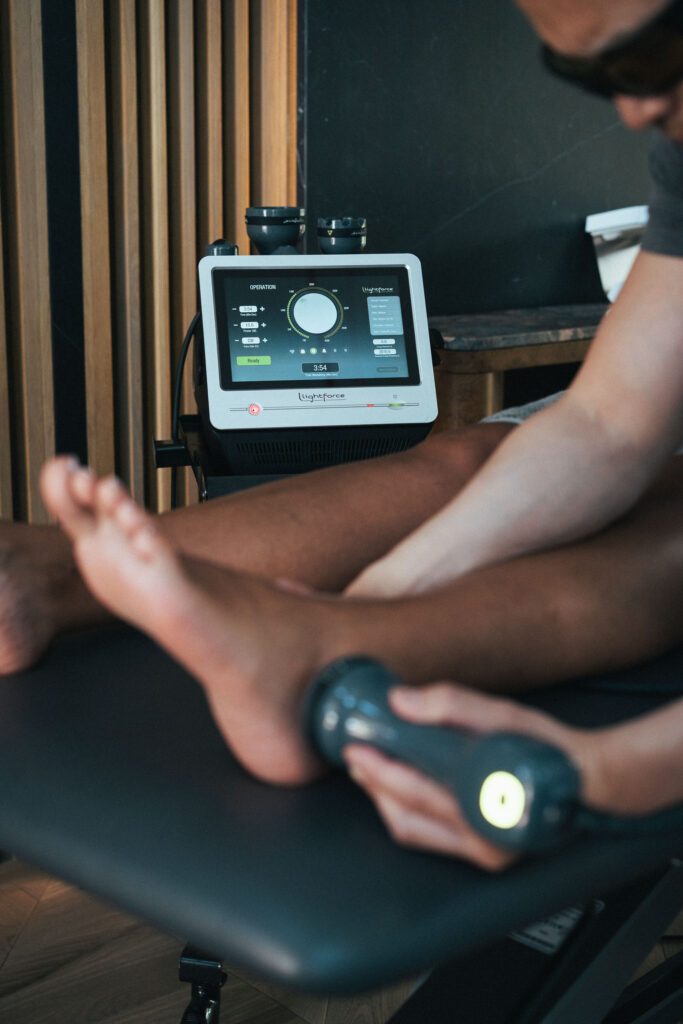
Photobiomodulation therapy (PBMT), commonly delivered using high-intensity laser systems, is increasingly used within musculoskeletal rehabilitation.
At a cellular level, PBMT stimulates photochemical reactions within tissue, supporting biological processes associated with pain relief and tissue repair processes (Karu et al 2003). Research by de Silva (2023) has demonstrated effects including:
- Increased synthesis of ATP
- Increased microcirculation
- Reduced inflammatory markers
- Support for tissue repair processes
From a rehabilitation perspective, the value of PBMT lies in its ability to support progression through loading phases that might otherwise be limited by symptoms.
For active populations, this can help physiotherapists maintain rehabilitation intensity while supporting patient comfort and confidence throughout recovery.
Explore How These Modalities Are Being Used in Practice
Looking for a deeper understanding of how rehabilitation technologies can be integrated into clinical care?
Our free webinar library provides physiotherapists with access to expert-led educational sessions covering:
- Shockwave therapy in musculoskeletal rehabilitation
- Photobiomodulation therapy and tissue recovery
- Neuromuscular electrical stimulation (NMES)
- Sports injury rehabilitation and return-to-activity planning
👉 [Explore the Webinar Library]
Shockwave Therapy in Contemporary Rehabilitation
Extracorporeal Shockwave Therapy (ESWT) has become an established modality in musculoskeletal rehabilitation and sports medicine.
Shockwave therapy delivers acoustic pressure waves into tissue, creating a mechanical stimulus that triggers biological responses through a process known as mechanotransduction.
For clinicians managing ankle sprains, this may help support rehabilitation by:
- Modulating pain and tissue sensitivity
- Supporting tissue adaptation
- Facilitating progression into higher-load activities
Its role can be particularly valuable during mid-to-late rehabilitation phases, where pain may become the primary factor limiting progression despite improvements in strength and mobility.
As patients transition toward running, directional changes, and sport-specific movements, shockwave therapy can be used alongside exercise-led rehabilitation to help support continued progression.
NMES: Supporting Strength and Neuromuscular Function
Neuromuscular Electrical Stimulation (NMES) can play an important role throughout the rehabilitation continuum, particularly when muscle inhibition or reduced activity levels limit effective loading.
Following an ankle sprain, the peroneal muscles can experience weakness or reduced activation, potentially impacting stability, proprioception, and movement efficiency.
NMES may be used to:
- Support neuromuscular activation
- Assist maintenance of muscle function during periods of reduced loading
- Enhance proprioceptive awareness
- Complement active exercise programmes
As rehabilitation progresses, research demonstrates that combining active exercise and NMES provides far superior results that either one alone (Choi et al 2024, Toyoshima et al 2021).
The Role of Bracing During Rehabilitation

While often considered separately from rehabilitation technologies, bracing can play an important role in supporting recovery following ankle sprain.
Appropriate external support may:
- Protect healing tissues
- Enhance proprioceptive feedback
- Improve confidence during movement
- Facilitate graded exposure to higher-risk activities
For active individuals returning to running or sport, bracing can provide reassurance during the transition back to activity while strength, neuromuscular control, and load tolerance continue to develop.
As with other supportive interventions, bracing is most effective when used to complement active rehabilitation rather than replace it.
A Multimodal Approach to Rehabilitation
Successful ankle sprain rehabilitation rarely depends on a single intervention.
Progressive exercise remains the foundation of recovery, but adjunctive technologies may provide valuable support at key stages of the rehabilitation journey.
A multimodal strategy may combine:
- Progressive loading and strengthening
- Neuromuscular and proprioceptive training
- Photobiomodulation therapy
- Shockwave therapy
- Neuromuscular electrical stimulation
- Appropriate bracing strategies
Together, these approaches can help support rehabilitation progression while respecting the practical realities of returning to activity.
Take Your Rehabilitation Strategy Further
Modern ankle sprain rehabilitation isn't about using more tools—it's about using the right tools at the right time.
Our comprehensive eBook, Ankle Sprain Rehabilitation: From First Steps to Full Activity, explores:
- Progressive rehabilitation strategies
- Shockwave therapy, PBMT, and NMES integration
- Bracing considerations across the rehabilitation continuum
- Return-to-activity planning for active populations
- Practical insights into multimodal rehabilitation
Conclusion
Adjunctive therapies are becoming an increasingly valuable component of ankle sprain rehabilitation. When integrated into structured, exercise-led programmes, technologies such as shockwave therapy, photobiomodulation therapy, and NMES can help support recovery, maintain rehabilitation momentum, and facilitate progression toward meaningful activity goals.
For physiotherapists working with active populations, the opportunity lies not in replacing established rehabilitation principles, but in enhancing them through carefully considered, multimodal approaches that help patients return to the activities that matter most.
References:
- Karu TI. Low power laser therapy. In: Vo-Dinh T, editor. Biomedical Photonics Handbook. Boca Raton (FL) CRC Press; 2003: 48-1-48-25.
- da Silva, T.G., Ribeiro, R.S., Mencalha, A.L. et al. Photobiomodulation at molecular, cellular, and systemic levels. Lasers Med Sci 38, 136 (2023)
- Choi S, Jun HP. (2024), Effects of Rehabilitative Exercise and Neuromuscular Electrical Stimulation on Muscle Morphology and Dynamic Balance in Individuals with Chronic Ankle Instability. Medicina (Kaunas). Jul 22;60(7):1187
- Toyoshima Y, Akagi R, Nabeshima K. (2021), Isometric exercise during immobilization reduces the time to return to play after lateral ankle sprain. Phys Ther Sport. Nov;52:168-172